
Analysis
Florida’s Public Mold-License File Shrunk After July 31. Here’s What Changed.
By Tyler Silva · Florida License Index · Published · Data checked through August 14, 2026 · [email protected]
A Florida License Index analysis of dated Florida DBPR files traces the records that remained, changed, appeared, or were no longer included after the 2026 renewal deadline. Absence from the state’s downloadable file does not, by itself, establish a license’s legal status.
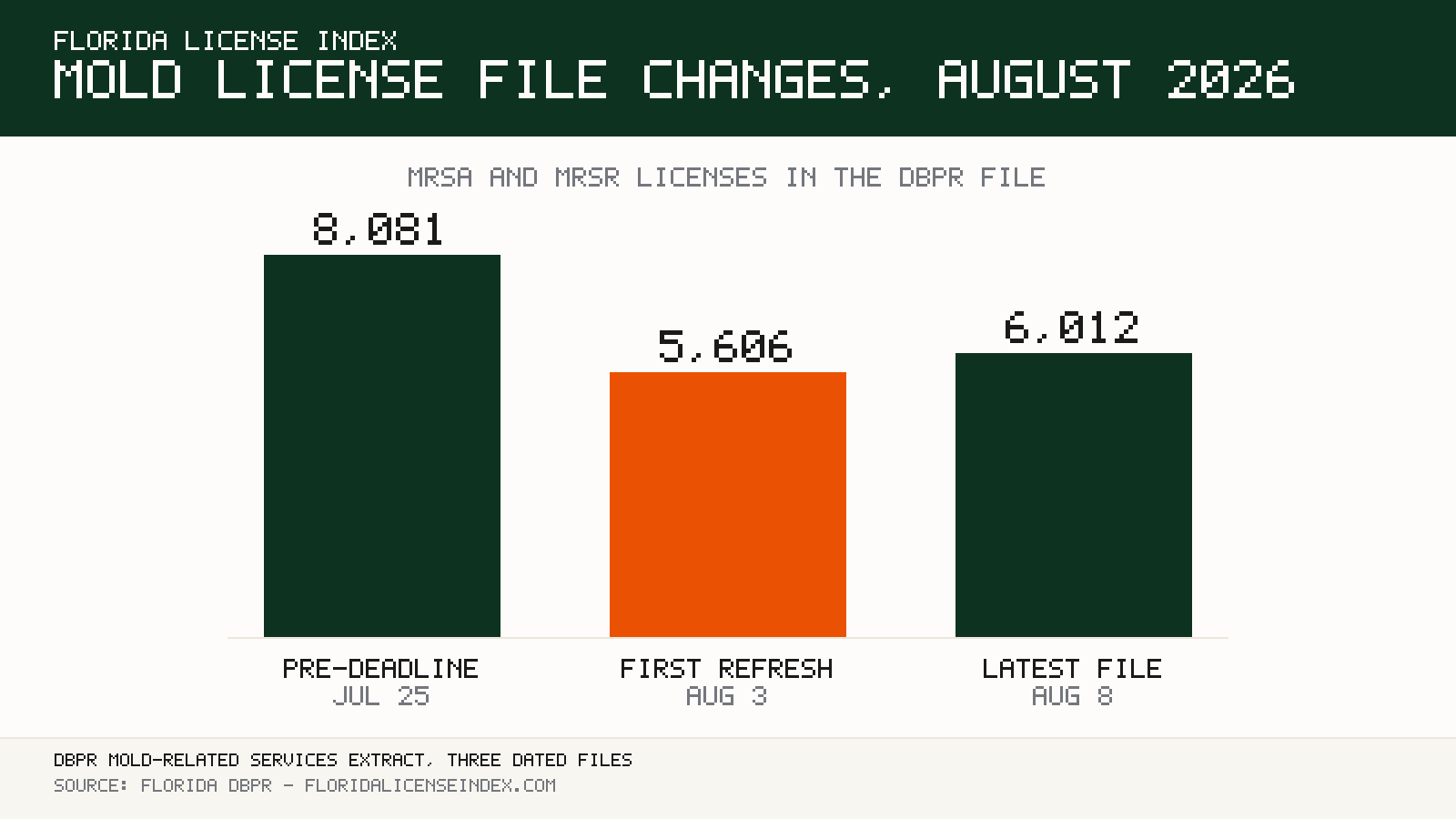
Florida’s DBPR Mold-Related Services file listed 8,081 active or inactive mold assessor and mold remediator license records in the file it was serving through the July 31, 2026 renewal deadline. Of those, 4,751 showed July 31, 2028 in DBPR’s expiration-date field, while 3,330 still showed July 31, 2026 as the deadline arrived. Two weeks later, the state’s own public data file looks different: the most recent version of that same file, published by DBPR on August 8 and unchanged through August 14, 2026, lists 6,012 records — a decline of 2,069, or 25.6%, from the pre-deadline total.
That is a fact about a file. It is not, by itself, a fact about who is currently licensed to assess or remediate mold in Florida.
Florida License Index compared three dated snapshots of DBPR’s own bulk-data extract — one from before the deadline, one from DBPR’s first refresh of the file afterward, and one from DBPR’s second refresh, the most recent available — to see exactly what changed, what didn’t, and what the file itself can and cannot tell us. The clearest single finding is also the reason this article is careful with its own numbers: 389 records that were absent from DBPR’s first post-deadline file were present again in the second, where they showed July 31, 2028 in DBPR’s expiration-date field. The first post-deadline file was therefore not the last state observed. That is not a reason to distrust the data. It is a reason not to read any single dated file as a final word.
Statewide results
DBPR’s Mold-Related Services download covers two license types under Florida’s biennial mold-licensing law: mold assessors (MRSA), who inspect and test for mold, and mold remediators (MRSR), who remove it. Both renew on the same July 31 cycle, in even years, under Chapter 468, Part XVI of the Florida Statutes.
Comparing DBPR’s pre-deadline file to its most recent post-deadline file:
- 8,081 → 6,012 MRSA/MRSR records — a net decline of 2,069 (25.6%).
- 2,101 records (26.0% of the pre-deadline total) that were in DBPR’s file before the deadline are not in DBPR’s most recent file.
- 1,229 records show DBPR’s on-file expiration date move from July 31, 2026 to July 31, 2028 — the renewal signal this data carries.
- 32 records are new since the pre-deadline file; 17 of those had never appeared in any of the three files examined here before the most recent one.
- 389 records that were absent from DBPR’s first post-deadline file are present again, with the renewed expiration date, in DBPR’s second post-deadline file.
Every one of those figures was computed twice, using two independently written methods, and reconciles exactly against the size of the file it came from — the earlier file’s total always equals the records shared with the later file plus the records unique to the earlier one, and the same holds in reverse. Full reconciliation tables are published alongside this article’s methodology section, below.
Figure 1. Statewide MRSA/MRSR count, three DBPR files
DBPR’s published count of MRSA/MRSR license records dropped from 8,081 before the July 31, 2026 deadline to 5,606 in DBPR’s first post-deadline file, then partially recovered to 6,012 in DBPR’s most recent file.
Source: Florida DBPR Mold-Related Services bulk data extract, three dated pulls. Florida License Index analysis.
Processing timeline across available snapshots
DBPR does not republish this extract every day. Florida License Index pulls the file daily regardless, and the pulls show DBPR actually changed what it was serving twice since the deadline — not once, and not continuously.
| DBPR file state | First seen | Held through | MRSA/MRSR count |
|---|---|---|---|
| Pre-deadline | (Last-Modified Jul 25, 2026) |
Aug 3, 2026 | 8,081 |
| First post-deadline refresh | Aug 3–4, 2026 | Aug 8, 2026 | 5,606 |
| Second post-deadline refresh (latest confirmed) | Aug 8–9, 2026 | Through August 14, 2026 | 6,012 |
DBPR’s file didn’t move at all for three days after the deadline, then dropped by nearly a third in its first refresh — 2,490 records were no longer included in that file — followed by 406 appearances in its second. Of those 406 appearances, 389 were records present before the deadline, absent from the first post-deadline file, and present again in the second; only 17 had not appeared in either earlier file.
Between the first and second post-deadline refreshes measured here, no record present in the first disappeared from the second, while 406 records appeared. Whether that pattern continues, reverses, or holds cannot be determined from these files; DBPR could refresh the extract again.
MRSA/MRSR comparison
Mold assessors and mold remediators declined at close to the same rate: MRSA fell from 4,084 to 3,077 records (down 24.7%), MRSR from 3,997 to 2,935 (down 26.6%). Neither type of license concentrated the decline. Among records still in the file, the balance between the two categories barely moved — MRSA made up 50.5% of MRSA/MRSR records in the pre-deadline file and 51.2% in the latest confirmed file.
Status codes tell a narrower story than they might suggest. DBPR’s file marks each remaining record “A” (active) or “I” (inactive) — that field describes whether the license-holder asked DBPR to place the license in active or voluntarily inactive status, a choice made under F.S. 468.8417, and it is unrelated to whether the record is in the file at all. The active/inactive split among records that stayed in the file barely shifted: 92.2% active before the deadline, 92.6% active in the most recent file. The records that left the file didn’t leave because DBPR flipped a status field — they simply stopped being included, which is a different thing entirely (see “What file disappearance means and does not mean,” below).
Figure 3. MRSA vs. MRSR decline, pre-deadline to latest confirmed
Mold assessor (MRSA) and mold remediator (MRSR) license counts declined at close to the same rate from DBPR’s pre-deadline file to its most recent file — 24.7% and 26.6% respectively.
Source: Florida DBPR Mold-Related Services bulk data extract. Florida License Index analysis.
Geographic findings
DBPR’s extract carries a mailing county code for each license, resolvable to one of Florida’s 67 counties for roughly 92% of records in every file examined; the remainder are blank, DBPR’s own “Unknown” code, out-of-state, or foreign mailing addresses. Broward, Miami-Dade, Palm Beach, and Hillsborough counties are the four largest by mold-license volume in all three files, in that order, and stay that order throughout.
Their individual declines from the pre-deadline file to the latest confirmed file range from 19.0% (Hillsborough) to 29.3% (Miami-Dade), bracketing the 26.0% statewide figure for records no longer in the file. No single large county moved dramatically out of step with the others. That’s a real finding, and a limited one: it describes where the decline shows up in DBPR’s data, not where mold work is or isn’t happening.
A necessary caveat on “county” here: DBPR’s county code is the mailing address on file for the license-holder — an address of record, not a service area. The mailing address neither establishes nor limits a licensee’s service area; the extract contains no work-location data. This data says nothing about where any individual license-holder actually performs work, only where DBPR’s records show them receiving mail.
Figure 4. Largest counties by mold-license volume, decline pre-deadline to latest confirmed
Florida’s four largest counties by mold-license volume each declined within a few points of the statewide 26.0% figure — a broadly proportional pattern, not a geographic concentration. County reflects DBPR’s mailing address of record for the license-holder, not a work location or service area.
Source: Florida DBPR mailing county code, Florida License Index analysis. County reflects license-holder mailing address of record, not service area.
What changed after the first post-deadline artifact
Between DBPR’s first post-deadline file (August 4) and its second (August 9, unchanged through August 14, 2026), 413 things changed: 406 records appeared and 7 address fields changed. No record present in both post-deadline files showed a 07/31/2026 → 07/31/2028 expiration-date rollover during this window. The 389 returning records already showed 07/31/2028 when they appeared in the later file, and no record present in the earlier file disappeared from the later one.
The 406 new appearances are the headline number for this window, and they are not what they might look like at first. Comparing that cohort against the pre-deadline file shows that 389 of the 406 — drawn from the 2,490 records present before the deadline but absent from the first post-deadline file — were present before the deadline, absent from the first post-deadline file, and present again in the second with 07/31/2028 in DBPR’s expiration-date field. Only 17 had not appeared in either earlier file. The 406 figure therefore cannot be interpreted as 406 newly issued credentials. Why any individual record followed that pattern is not something these files establish.
This is the clearest evidence in this dataset that a single dated file, examined in isolation, cannot be read as a final outcome. It is also why this article does not describe the 2,101 records absent from DBPR’s latest confirmed file as a completed or final count.
Figure 2. Where the 406 August 9 additions came from
Of the 406 records added to DBPR’s file between its first and second post-deadline versions, 389 (95.8%) were present in the pre-deadline file, absent from the first post-deadline file, and present again in the second; 17 (4.2%) were not present in either earlier file.
Source: Florida License Index analysis of three dated DBPR files; see methodology.
What file disappearance means and does not mean
This is the part of the story that determines everything else, so it’s worth stating plainly and sourcing carefully.
DBPR’s Mold-Related Services download includes active, inactive, and voluntarily inactive licensees. It does not include null-and-void, delinquent, or involuntarily inactive records — and it does not distinguish among those three when it excludes them. That means a record’s disappearance from the file establishes only that DBPR stopped including it. It does not, by itself, establish which of those statuses applies, or whether any currently does.
Florida law treats “delinquent” and “void” as different things, not synonyms. Under F.S. 455.271, which governs license status across DBPR’s boards generally, a license that isn’t renewed by its expiration date becomes delinquent — and a delinquent license does not authorize a person to practice. But delinquent is not the end of the process: a license only becomes void, “without any further action by the board or the department,” if it remains unrenewed through the following full license cycle — for a biennial license like this one, that is a much longer runway than the two weeks separating DBPR’s two post-deadline files examined here. A record can be delinquent, in a state where practice isn’t authorized, and still be a very different thing legally from void, and DBPR’s downloadable extract does not tell a reader which — if either — applies to any specific absent license.
None of the 2,101 records absent from DBPR’s latest confirmed bulk file were individually confirmed against DBPR’s live lookup for this analysis. That is deliberate. This article reports what DBPR’s own dated, downloadable files show; it does not perform live verification, and it is not a substitute for one.
Implications for license holders, employers, and consumers
For a license-holder whose record is no longer in DBPR’s downloadable file: that absence alone doesn’t tell you your legal status, and it isn’t the same as being told you failed to renew. This analysis found 389 records that were absent from one dated DBPR file and present again with 07/31/2028 in DBPR’s expiration-date field in the next — direct proof that absence from a single file is not a final outcome for every record it happens to. Check your status directly with DBPR (see below), and if this article or the underlying site data ever shows your license status incorrectly, contact us — errors like this are exactly what corrections are for.
For a homeowner or business hiring a mold assessor or remediator: DBPR’s downloadable file is not the same tool as DBPR’s live license lookup. If you’re deciding whether to hire someone, confirm their license status directly with DBPR at the time you hire them, not from an archived comparison like this one.
For employers and referral sources: the same caution applies in reverse. A license absent from a dated file is not, by itself, grounds to treat someone as unlicensed.
How to verify a current credential through DBPR
DBPR’s own live license lookup — not this article, and not any dated download — is the authoritative source for a license’s current status. It’s available at myfloridalicense.com’s license search tool. Search by name or license number; the result reflects DBPR’s records at the moment you search, not a file from a particular date. If you hold a Mold-Related Services license and believe DBPR’s file doesn’t reflect a renewal you completed, DBPR’s renewal-status tools (under Licensing & Regulation → Mold Related Services → Manage My License) show your continuing-education completion status directly.
Detailed methodology
This analysis compares DBPR’s own “Mold-Related Services” bulk data extract (lic07mold.csv), pulled directly from DBPR’s public download endpoint, at three points: the file DBPR was serving through the July 31, 2026 deadline (Last-Modified July 25, 2026; confirmed identical across five separate pulls, July 30 through August 3); the first file DBPR served afterward (Last-Modified August 3, 2026; confirmed identical across five pulls, August 4 through August 8); and the second, and so far most recent, file DBPR has served since (Last-Modified August 8, 2026; confirmed identical across pulls from August 9 through August 14, 2026, including an independent publication-day re-download performed the same day this article was prepared).
Each file is DBPR’s own fixed-format download — no header row, a documented 22-field layout — filtered to the two mold license types under the July 31 renewal cycle: MRSA (mold assessor) and MRSR (mold remediator). Every record’s unique DBPR license identifier is used to match it across files. A record present in an earlier file and absent from a later one is counted as no longer included; a record whose on-file expiration date moves from July 31, 2026 to July 31, 2028 is counted as an expiration-date rollover — the renewal signal available in this extract, not a legal or transactional conclusion; a record present in a later file but not an earlier one is counted as new to that file.
Every total in this report reconciles exactly: the count of records present in both files, plus the count present only in the earlier file, equals the earlier file’s total; the analogous identity holds for the later file. Each reconciliation was computed twice, by two independently written methods, with identical results both times.
Statutory context — the definitions of active, inactive, delinquent, and void status, and the biennial renewal cycle itself — comes from Florida Statutes Chapter 468, Part XVI (Mold-Related Services) and Chapter 455 (professional regulation generally), not from DBPR’s data file.
Reconciliation
Every comparison below satisfies the same identity: the earlier file’s total equals the records shared with the later file plus the records unique to the earlier file, and the later file’s total equals the same shared count plus the records unique to the later file. Each was computed twice, by independently written methods, with identical results both times.
| Comparison | Earlier total | Later total | Shared (present in both) | Earlier-only | Later-only | Reconciles |
|---|---|---|---|---|---|---|
| PRE → POST1 | 8,081 | 5,606 | 5,591 | 2,490 | 15 | 8,081 = 5,591 + 2,490 ✓ · 5,606 = 5,591 + 15 ✓ |
| POST1 → LATEST | 5,606 | 6,012 | 5,606 | 0 | 406 | 5,606 = 5,606 + 0 ✓ · 6,012 = 5,606 + 406 ✓ |
| PRE → LATEST | 8,081 | 6,012 | 5,980 | 2,101 | 32 | 8,081 = 5,980 + 2,101 ✓ · 6,012 = 5,980 + 32 ✓ |
The PRE → LATEST window is not an independent finding; it is a closed-form arithmetic check on the two-step comparison, computed with a third, fully independent code path that never touches the POST1 file. It agreeing exactly with the two-step figures (2,490 − 389 = 2,101; 840 + 389 = 1,229; 15 + 17 = 32) is the strongest evidence available that the parsing and reconciliation are internally consistent.
Source artifacts
| Artifact | DBPR Last-Modified | Retrieval | SHA-256 | Byte count | MRSA | MRSR | Combined | Expiration-date distribution |
|---|---|---|---|---|---|---|---|---|
| PRE (pre-deadline) | Sat, 25 Jul 2026 10:49:14 GMT | Banked 2026-08-01T04:03:23Z; byte-identical 2026-07-30 through 2026-08-03 | 3b0fd6a002b68f8ad5fd57cba116e87d10928f9f80cb1109863762e17db718f7 | 1,519,229 | 4,084 | 3,997 | 8,081 | 3,330 showed 07/31/2026; 4,751 showed 07/31/2028 |
| POST1 (first post-deadline) | Mon, 03 Aug 2026 13:34:09 GMT | 2026-08-04T11:17:21.960Z; byte-identical through 2026-08-08 | a2e564b3791fb37baf6dbf5a8949dc7ae5e65156b69e741f18336b6b1a9d86e3 | 1,077,607 | 2,875 | 2,731 | 5,606 | 5,606 showed 07/31/2028 (100% of records in that file) |
| LATEST (second post-deadline, latest confirmed) | Sat, 08 Aug 2026 10:49:29 GMT | 2026-08-09T09:31:39.653Z; byte-identical through 2026-08-14 — re-confirmed by an independent publication-day download | c0beec4bc3a67a886e9ca559171555a2248fb87b7edc03a2236cae495bf8d36e | 1,150,132 | 3,077 | 2,935 | 6,012 | 6,012 showed 07/31/2028 (100% of records in that file) |
Source: DBPR Mold-Related Services bulk data extract, three dated pulls, cross-checked against the repository’s own committed snapshot manifests. A machine-readable summary of these published aggregate figures — no private license data — is available at /data/mold-2026-aggregate.json.
Limitations
- This comparison is not settled. DBPR has published only two refreshed extracts since the July 31 deadline. The first moved the MRSA/MRSR count by more than 30% in a single step — well outside the range this analysis would treat as routine noise. A future DBPR refresh could still change the count of records included, excluded, or renewed. Every figure in this article is stated as of DBPR’s most recently confirmed file, not as a final outcome.
- Absence is not a status determination. As explained above, this file cannot and does not distinguish delinquent, void, or involuntarily inactive records from one another, or tell a reader which applies to a specific license.
- County reflects a mailing address of record, not a service area.
- This analysis did not individually verify any specific license against DBPR’s live lookup. It compares DBPR’s own dated downloadable files to each other, nothing else.
- A company or business name on a license record is not the same thing as an individual credential. DBPR’s extract ties a license to an individual license-holder; a business or “doing business as” name on the record identifies an associated company, not a separately licensed entity, and this analysis treats license-level changes and business-name changes as distinct findings rather than folding one into the other.
Corrections/update policy
Florida License Index publishes corrections openly, with dates, rather than silently editing published figures. If any number, date, or characterization in this article is wrong — including a license shown here as no longer in DBPR’s file that you know to have renewed on time — email [email protected] with the license number or a link to this article and what you believe is incorrect. A dated DBPR download and DBPR’s live record may differ; that is exactly the kind of discrepancy this corrections process is intended to address.
No corrections have been logged for this page yet.
Sources
- DBPR Mold-Related Services program page
- DBPR Mold-Related Services bulk data extract (the primary source for every figure in this article)
- DBPR license lookup (live verification)
- DBPR “Understanding DBPR Codes” (county-code legend)
- Florida Statutes § 468.84, Mold-related services licensing program; legislative purpose
- Florida Statutes § 468.8411, Definitions
- Florida Statutes § 468.8415, Renewal of license
- Florida Statutes § 468.8416, Continuing education
- Florida Statutes § 468.8417, Inactive license
- Florida Statutes § 468.8419, Prohibitions; penalties
- Florida Statutes § 468.8421, Insurance
- Florida Statutes § 455.271, Inactive and delinquent status