
Florida’s Electrical-Contractor File Changed After August 31. Here’s What the First Update Shows.
By Tyler Silva · Florida License Index · Published September 1, 2026 · Data checked through September 1, 2026 at 17:25 UTC · [email protected]
Florida License Index compared DBPR’s final captured Board 08 file before the August 31 deadline with the first changed file afterward. The results are observations about two dated files, not conclusions about why any individual record changed.
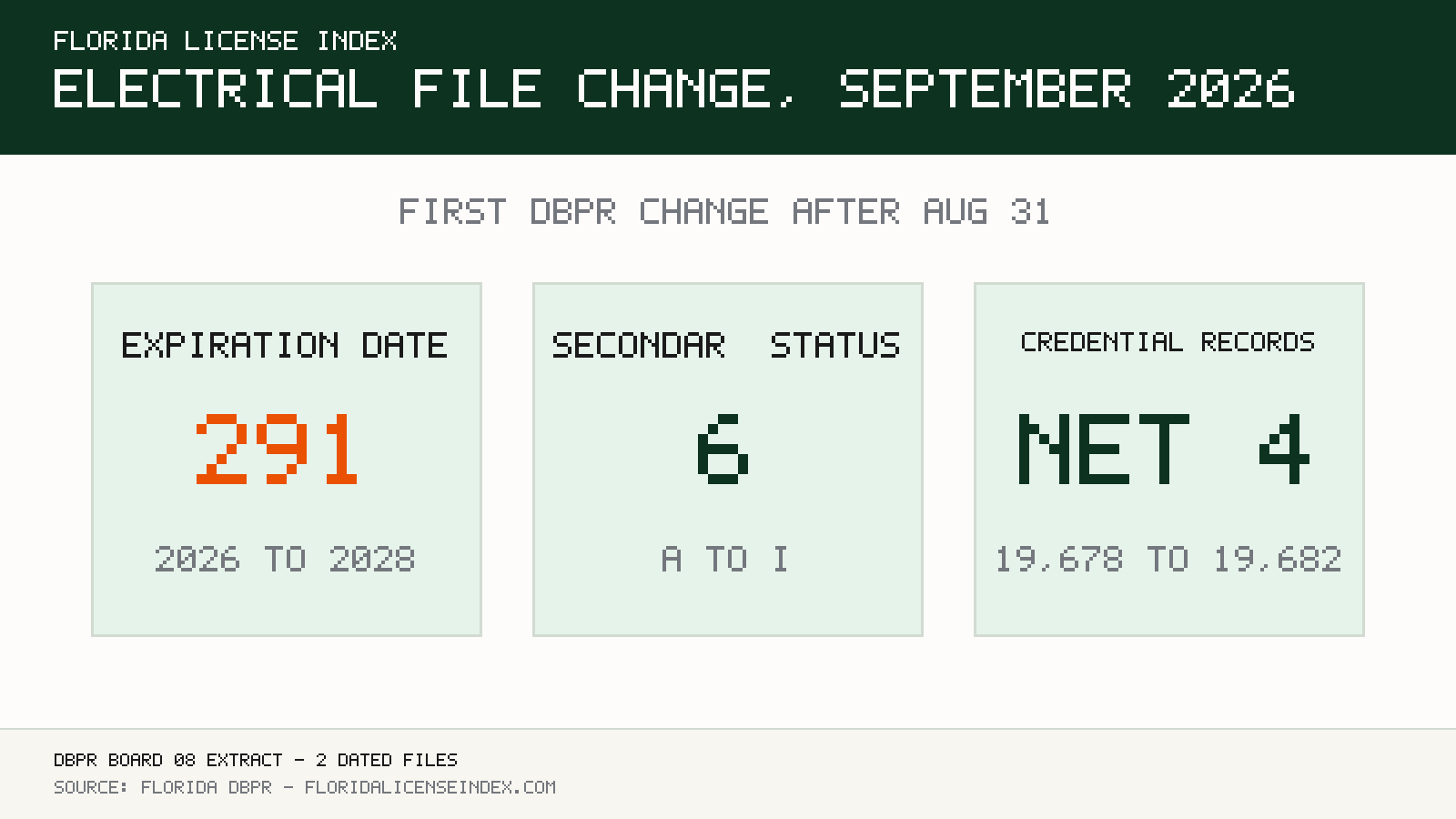
The first Electrical Contractors’ Licensing Board file Florida License Index captured after the August 31 deadline did not change. Its 21,777 rows and SHA-256 hash were byte-for-byte identical to the last file captured before the deadline. The state’s next version, first captured at 13:32 UTC on September 1, did change.
That sequence is the useful finding: it separates the deadline from the first observed file update instead of assuming the two happened simultaneously.
The Board 08 download contains more than contractor-license rows. It also carries 2,099 continuing-education course and provider rows, which were unchanged. After separating those rows, the number of electrical, alarm, and specialty contractor license-type rows moved from 19,678 to 19,682, a net increase of four.
What the first changed file shows
Comparing the terminal pre-deadline artifact with the first changed post-deadline artifact:
- 291 matched license-type rows changed from
08/31/2026to08/31/2028in DBPR’s expiration-date field. - Six matched license-type rows changed from
AtoIin DBPR’s secondary-status field. The file does not state why. - Six license-type rows appeared in the later file, while two were no longer present — a net increase of four.
- 323 matched license-type rows changed in at least one field. In addition to expiration and secondary status, the changed fields included names, business names, effective dates, and mailing-address fields. A row can change more than one field, so field-change counts are not additive.
The 291 figure is an exact field transition among rows whose identifiers are unique in both files. It is not a claim that Florida License Index independently confirmed 291 renewal transactions. Likewise, an A → I source-field change is not an explanation of what caused the change.
Figure 1. Expiration-date distribution among license-type rows
| DBPR expiration-date field | Terminal pre-deadline file | First changed post-deadline file | Net file change |
|---|---|---|---|
| 08/31/2026 | 3,197 | 2,905 | −292 |
| 08/31/2028 | 16,481 | 16,777 | +296 |
| All license-type rows | 19,678 | 19,682 | +4 |
The net distribution includes matched field changes, six later-file appearances, and two earlier-file-only rows. Of the matched rows, exactly 291 moved from the 2026 date to the 2028 date.
Source: Florida DBPR Electrical Contractors’ Licensing Board licensee extract, two dated artifacts. Florida License Index analysis.
The distribution changes by 292 and 296, rather than by 291 on each side, because the file also gained six license-type rows and lost two. All six later-file-only rows showed the 2028 date; of the two earlier-file-only rows, one showed 2026 and one showed 2028. Those are presence and field observations only.
The file changed after the deadline, not at the deadline
Florida DBPR says certified and registered electrical-contractor licenses expire August 31 in even years and identified August 31, 2026 as the current deadline. Florida License Index captured the public extract repeatedly around that boundary.
Figure 2. Observed Board 08 file sequence around August 31
| Capture | Retrieved (UTC) | DBPR Last-Modified | Rows | SHA-256 |
|---|---|---|---|---|
| Terminal pre-deadline | 2026-08-31 21:29:55 | 2026-08-31 10:46:29 GMT | 21,777 | 63181f37c77fb446dc57e1546963b13fa6bd529dd96f1a548adc12e085984324 |
| First post-deadline | 2026-09-01 05:18:06 | 2026-08-31 10:46:29 GMT | 21,777 | 63181f37c77fb446dc57e1546963b13fa6bd529dd96f1a548adc12e085984324 |
| First changed post-deadline | 2026-09-01 13:32:18 | 2026-09-01 10:45:59 GMT | 21,781 | 71bbe7369027d1982c14ece3c7836f2f4ff9e96aa35a9912584bba1fe89066c3 |
| Later confirmation | 2026-09-01 17:25:37 | 2026-09-01 10:45:59 GMT | 21,781 | 71bbe7369027d1982c14ece3c7836f2f4ff9e96aa35a9912584bba1fe89066c3 |
The first file captured after the deadline was byte-identical to the terminal pre-deadline file. The first observed change arrived in the next DBPR version.
Source: committed Florida License Index capture manifests and raw DBPR files. Times shown in UTC.
Capture time and DBPR’s Last-Modified time describe different events: when Florida License Index retrieved a response, and when DBPR’s server says that response was last modified. This analysis preserves both and does not substitute one for the other.
Which license types changed in net count
DBPR’s license-type descriptions distinguish statewide certified categories from locally limited registered categories. Only four occupation codes had a nonzero net count in this first changed file.
Figure 3. License-type rows with a nonzero net count
| DBPR code | License type | Before | After | Net |
|---|---|---|---|---|
| EC | Electrical Contractor | 13,242 | 13,245 | +3 |
| EF | Alarm System Contractor I | 1,635 | 1,636 | +1 |
| ES | Specialty Contractor | 1,994 | 1,995 | +1 |
| EY | Registered Alarm System Contractor I | 83 | 82 | −1 |
ER, EG, EH, EI, EZ, ET, and EJ had no net count change. ER nevertheless had one later-file appearance and one earlier-file-only row, which cancel in the net total.
Source: DBPR occupation-code field and DBPR license-type descriptions.
What appearance, disappearance, and A → I do not establish
DBPR’s Electrical Contractors public-records page says the licensee download includes active, inactive, and voluntarily inactive licensees. It also says null-and-void, delinquent, and involuntarily inactive records are excluded.
That exclusion rule is why a row no longer present in this download cannot be assigned a legal status from absence alone. The file does not identify which excluded category — if any — explains a specific absent row. A later-file appearance also does not, by itself, establish that a credential was newly issued.
Florida law separately defines the renewal process and license statuses. F.S. 489.517 governs biennial renewal and continuing education for electrical and alarm-system contractors; F.S. 489.519 addresses inactive status; and F.S. 455.271 addresses inactive and delinquent status generally. Those legal rules supply context. They do not turn a two-file comparison into an individual adjudication.
Detailed methodology
This analysis uses DBPR’s fixed-format lic08el.csv extract. Each stored artifact was verified against its capture manifest for SHA-256, byte length, row count, and 22-field consistency through the end of the file. Every row in both compared artifacts carried board code 08, and every occupation code was in the closed set documented for this source.
The same file includes contractor license types and continuing-education records. License-type totals here include EC, ER, EF, EG, EY, EH, EZ, EI, ES, ET, and EJ. Course and provider codes CRS1, CRS2, CRS3, and PVDR are counted separately; their combined 2,099 rows were unchanged.
Rows were grouped using DBPR’s Alternate Lic# field. A plain one-row-per-identifier map would be unsafe because each artifact contains 36 duplicated identifiers, plus one row with a blank identifier. The reconciliation therefore treats each identifier group as a multiset and removes byte-identical rows first. In these two artifacts, all 36 duplicated groups were identical as multisets. Every reported changed match occurred on an identifier that appeared exactly once in each file. If multiple nonidentical candidates had remained in a duplicate group, the analysis would have stopped rather than selecting a closest-looking record.
The arithmetic reconciles in both directions:
- 21,777 earlier rows = 21,775 matched + 2 earlier-only.
- 21,781 later rows = 21,775 matched + 6 later-only.
- Among the 21,775 matched rows, 21,452 were unchanged and 323 changed in at least one field.
- All 323 changed matched rows, all six later-only rows, and both earlier-only rows were license-type rows. All 2,099 course/provider rows were unchanged.
A machine-readable copy of these aggregate figures — with no names, addresses, or license identifiers — is available at the ECLB September 2026 aggregate JSON.
How to verify a current license
This article is an archived comparison of dated files, not a current-status lookup. For a present-tense decision, use DBPR’s live license search and check the specific credential at the time you need it.
Limitations
- This is the first changed post-deadline file, not a final outcome. Later DBPR versions may change the population and field distributions again.
- File presence is not legal status. The download’s exclusion rules prevent absence from identifying whether a record is delinquent, involuntarily inactive, null and void, or absent for another reason.
- A field transition does not reveal cause. This analysis does not infer why an expiration date, secondary status, name, business name, effective date, or mailing field changed.
- No individual license was checked against the live lookup for this aggregate report. The analysis compares DBPR’s own dated downloadable files to each other.
- The full file row count is not a license count. Continuing-education course and provider rows were separated from contractor license-type rows before reporting totals.
Corrections/update policy
Florida License Index publishes dated corrections rather than silently changing reported figures. If a number, date, source characterization, or method here is wrong, email [email protected] with this article’s URL and the evidence supporting the correction.
No corrections have been logged for this page yet.
Sources
- DBPR Electrical Contractors’ Licensing Board program page — license types and the 2026 renewal deadline
- DBPR Electrical Contractors public-records page — file layout and inclusion/exclusion rules
- DBPR Board 08 licensee extract — primary data source
- DBPR live license search — current verification
- Florida Statutes § 489.517 (2026) — renewal and continuing education
- Florida Statutes § 489.519 (2026) — inactive status
- Florida Statutes § 455.271 (2026) — inactive and delinquent status